Current Conditions

Click on the images below to see the full-size version.

Update on the California Drought: :  November 8 – December 12, 2016

From the Pacific Institute’s California Drought Response Team

Top Story

California’s Controversial Drought Provisions Passed by Congress

A controversial California drought package was approved by the House and the Senate after its inclusion in the fast-moving $10 billion Water Infrastructure Improvements for the Nation Act a week earlier. Crafted by Republican House Majority Leader Kevin McCarthy and Democratic Senator Dianne Feinstein, the California-related provisions increase water pumping from the Sacramento-San Joaquin Delta for farming and other purposes in Central and Southern California. The bill also directs $558 million to desalination, water recycling, and water storage projects, among other proposals.

The California drought package was opposed by retiring Senator Barbara Boxer (D-CA) on the grounds that it would undermine the Endangered Species Act protections and adversely affect fisheries and fishing communities. It marks a significant shift in federal policy established under the 1992 Central Valley Project Improvements Act (CVPIA), which focused on the protection of the Delta and endangered species.

The Water Infrastructure Improvement Act passed with a 360-61 vote by the House and a 78-21 vote by the Senate. It is awaiting approval by President Barack Obama.


In Other News

  • Californians have continued to save water despite the easing of mandated conservation targets in May 2016. Urban water use in October was 19.5% less than the same month in 2013. While water savings were 2.8 percentage points lower than in October 2015, they represented a slight improvement from the 18.3% savings in September 2016. Cumulative water savings from June 2015 through October 2016 were 22.8%, or about 2.3 million acre-feet.
  • California state agencies recently released a draft plan to move the state toward using water more wisely, preparing for future droughts, and preventing water emergencies for vulnerable communities. The draft plan helps to fulfill the first directive of the California Water Action Plan: “Make Conservation a California Way of Life.” Proposed measures include developing new water use targets for urban water utilities that go beyond the existing requirements, permanent prohibitions of wasteful water use practices, monthly water use reporting, and reducing leaks in the water-delivery system.
  • The Department of Water Resources (DWR) set the initial State Water Project (SWP) allocation at 20%, citing that “October’s storms and subsequent rainfall have brightened the picture, but [California] could still end up in a sixth year of drought.” Initial allocations frequently change. For example, last year’s allocation was initially set at 10% and was later revised to 60%.
  • The U.S. Forest Service has identified an additional 36 million dead trees across California, bringing the total number of dead trees since 2010 to over 102 million on 7.7 million acres of the state’s drought-stricken forests. More trees are expected to die in the coming months and years because of the drought.
  • To limit wildfire threats, Cal Fire – the state’s fire management agency – has awarded more than $15 million to various fire safe councils and resource conservation districts across California. These Fire Prevention and Tree Mortality Grants will support fire prevention and suppression programs in rural California.
  • The Rancho California Water District in Riverside County has started a program to help district growers replace water-intensive crops, such as avocado, with lower water-use crops, such as wine grapes and citrus trees. The program is funded by a $3 million grant from the U.S. Bureau of Reclamation and the Department of Water Resources, as well as district resources.
  • The population of endangered winter-run Chinook salmon has rebounded this year. About twice as many winter-run salmon have been counted on the Sacramento River compared to 2015. Although conditions are still poor, this is a promising development as only 5% and 3% of juvenile winter-run salmon survived in 2014 and 2015, respectively. The long-term average survival rate is about 26.4%.


California Drought Status

Drought Monitor

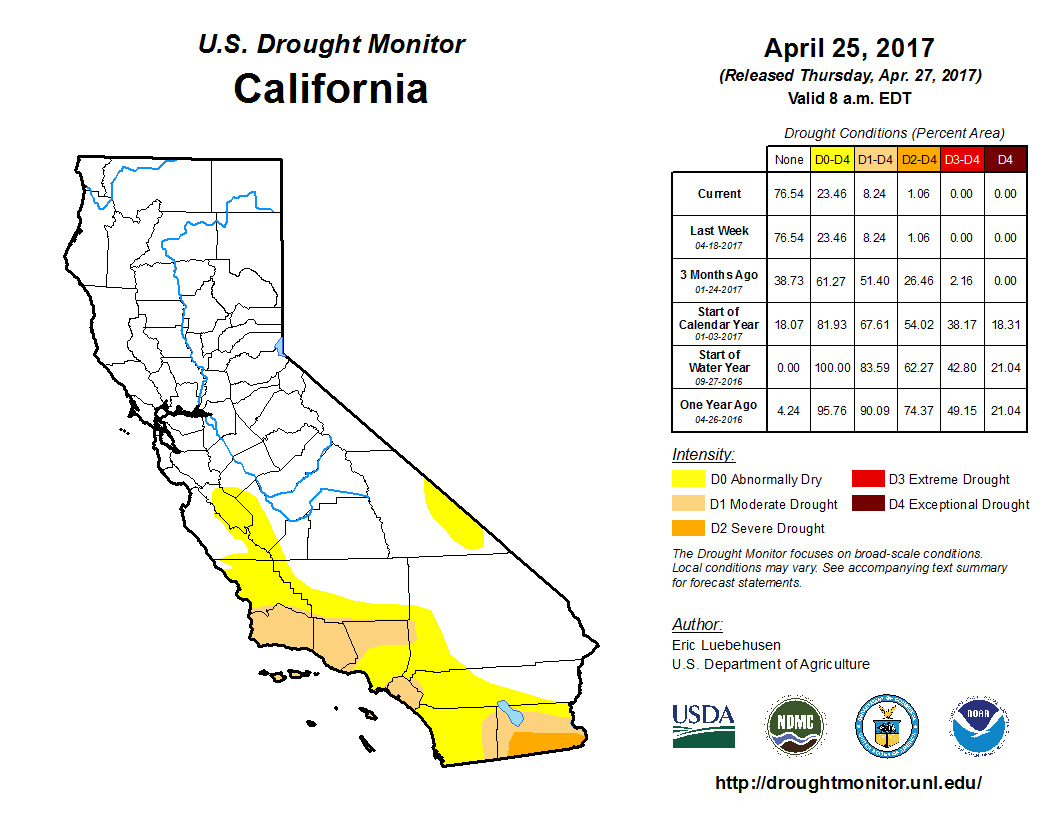
About 43% of the state remains in extreme-to-exceptional drought, the same as three months ago. Moderate-to-severe drought conditions affect 32% of the state, the same as last month. About 12% of the state is now identified as drought-free, namely Del Norte, Humboldt, Siskiyou, and most of Trinity and Shasta counties.

Precipitation

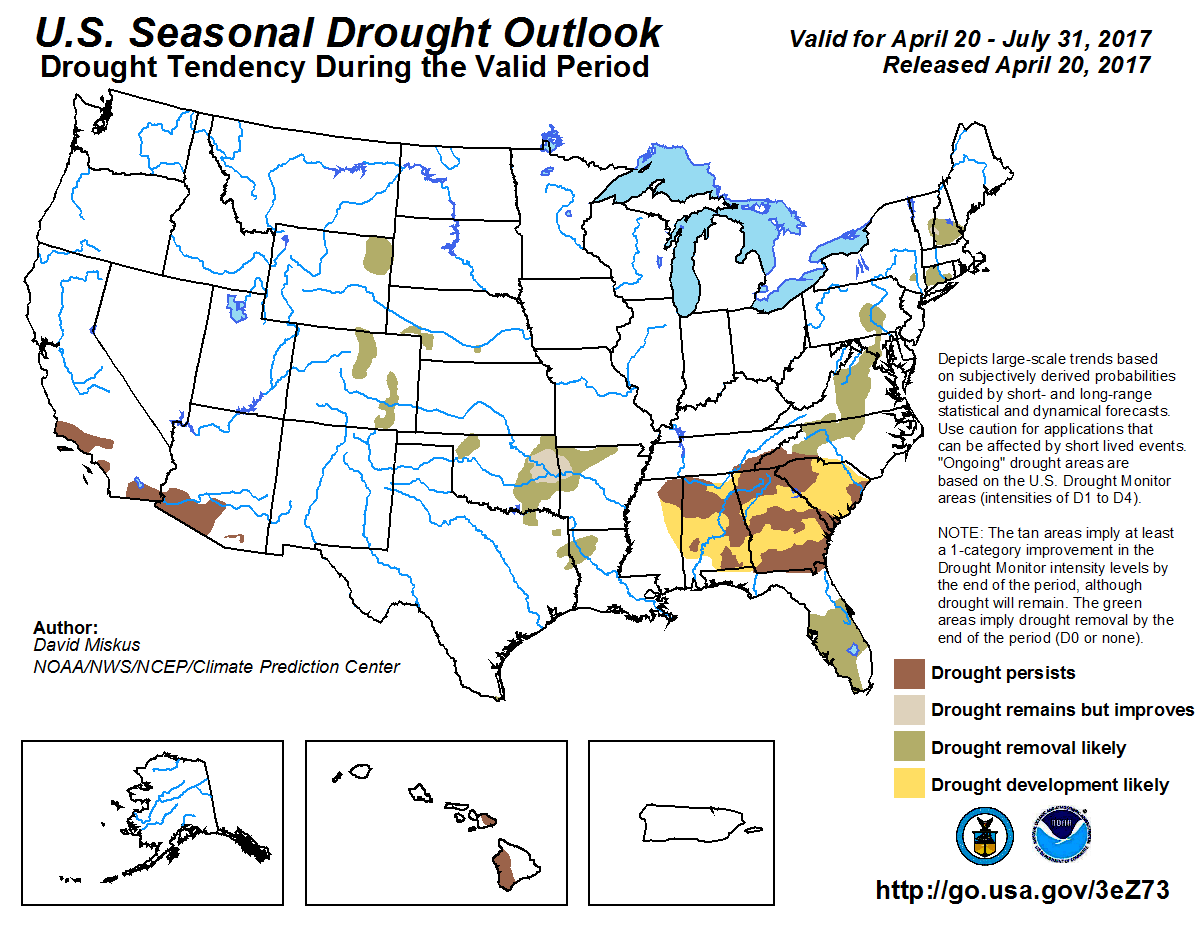
According to the National Oceanic and Atmospheric Administration’s December forecast, La Niña weather conditions are now present, but the weather pattern will likely transition back to normal during January to March 2017. La Niña is expected to contribute to above-average temperatures and below-average precipitation across much of the southern regions of the U.S., including Southern California.

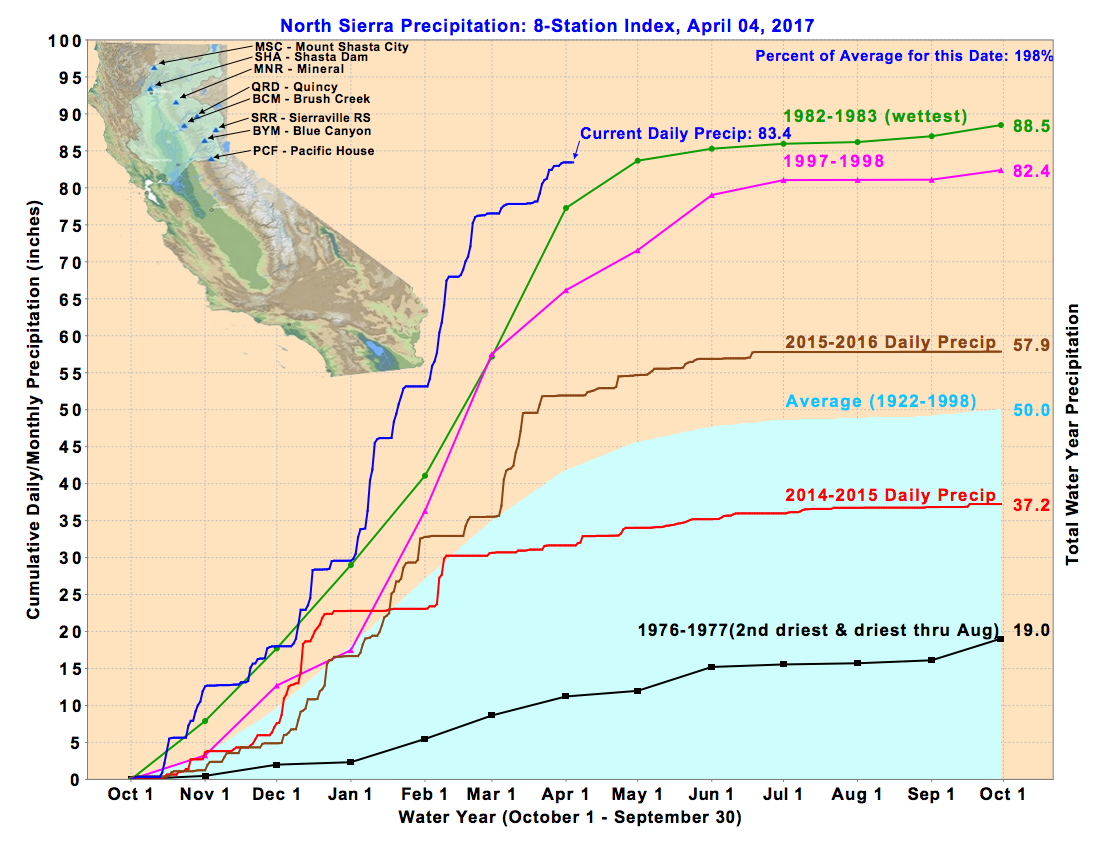
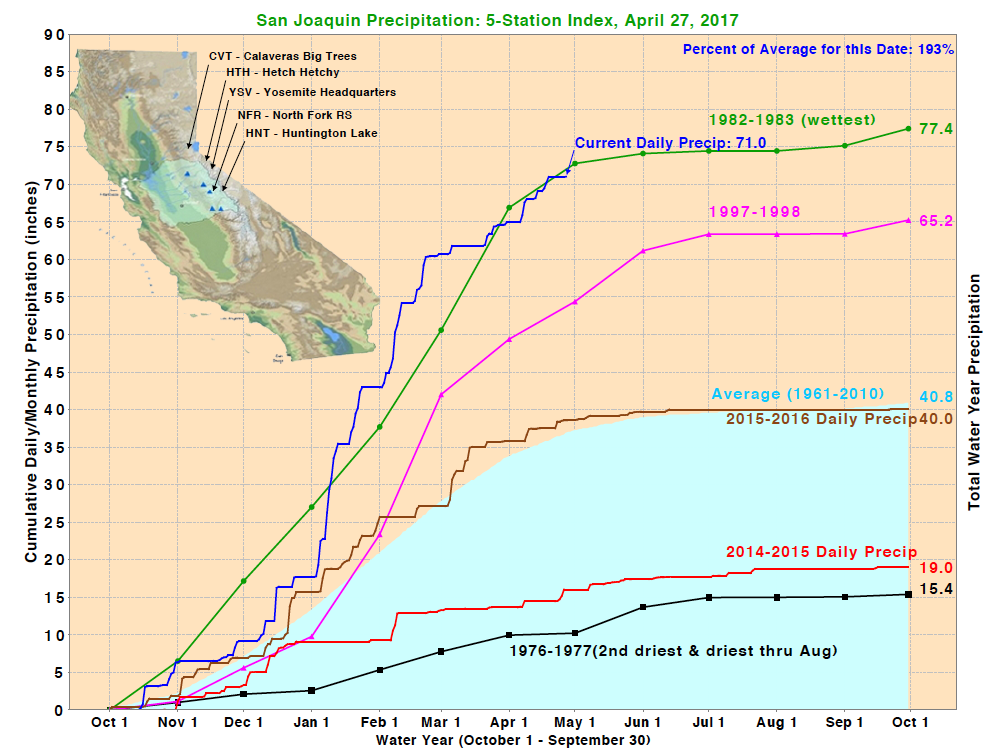
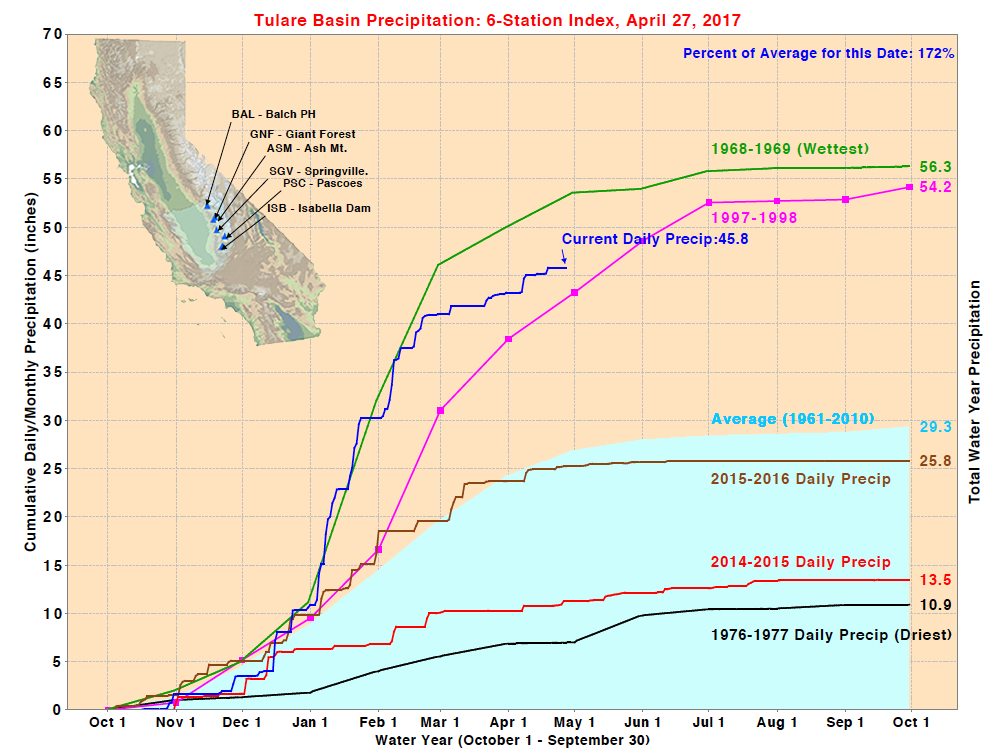
Since the beginning of the water year on October 1, 2016, cumulative precipitation in California’s three key hydrologic regions have varied quite drastically. The Northern Sierra region is experiencing the wettest winter in 30 years, having received about 22.9 inches of rain and snow. In the San Joaquin region, cumulative precipitation is about 2.5 inches above average. However, the Tulare Basin continues to receive very low levels of precipitation, similar to the dry 2014/15 pattern.

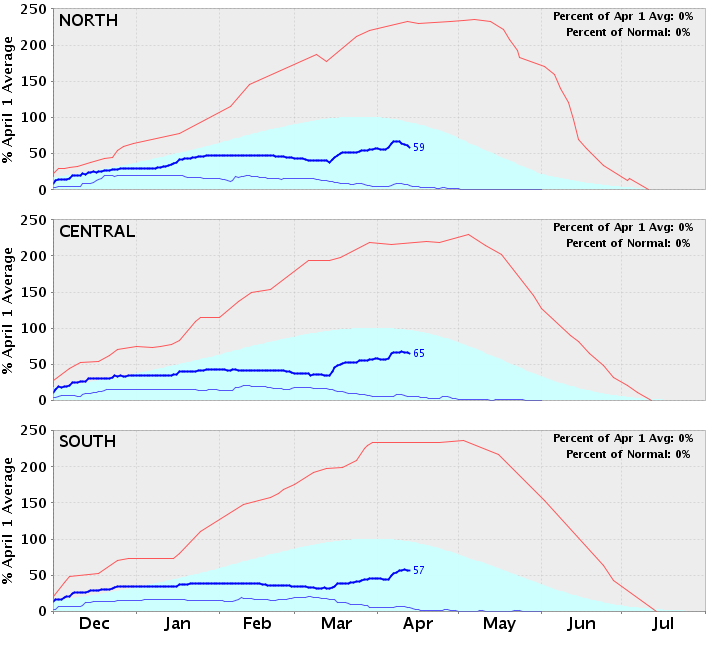
Despite a relatively wet start to the winter season, recent storms have not restored the state’s snowpack to normal levels. Statewide snow-water equivalent (or the amount of water contained within the snowpack) is about 57% of the normal level for December 12.

Reservoir Conditions

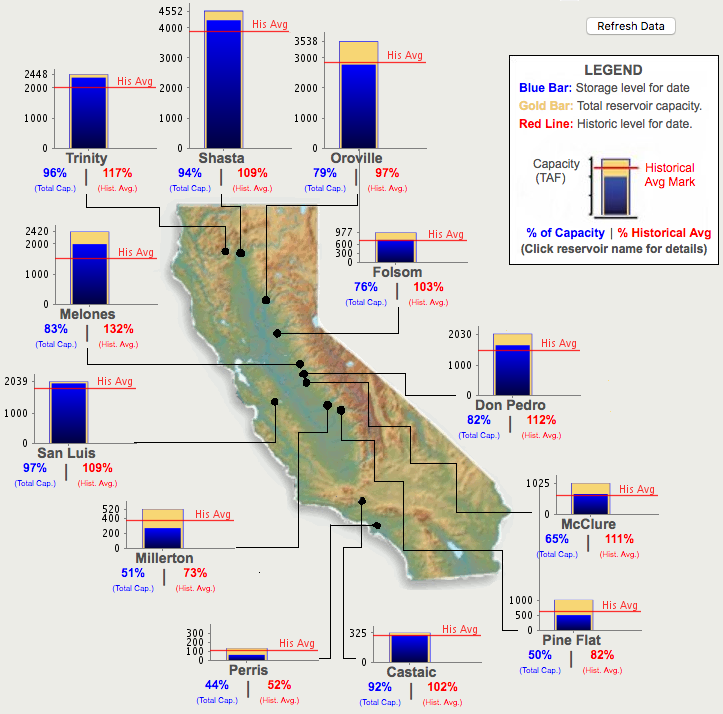
After the October rains, the water level in California’s major reservoirs (representing 27.3 million acre-feet of storage) has increased by five percentage points to 50% of the statewide capacity compared to a month ago (as of 12/12/16). Current storage levels represent 87% of the historical average for this time of year, also five percentage points higher than last month. Conditions in individual reservoirs vary across the state, with those in the north continuing to do better than those further south. For example:

  • The water level at Lake Shasta is at 109% of the historical average. Lake Oroville and Folsom Lake are at 73% and 127% of the historical average, respectively.
  • The water level at the New Melones Reservoir, another major reservoir with a 2.4 million acre-feet capacity, is at 40% of the historical average.
  • The water level at the San Luis Reservoir hit its lowest level in 27 years in mid-August and now stands at 80% of the historical average for this date.
  • Lake Cachuma, which supplies water to the city of Santa Barbara and other urban areas in Southern California, remains very low at 7% of its capacity at least since August 2016. The current level is 10% of the historical average.


Wildfires

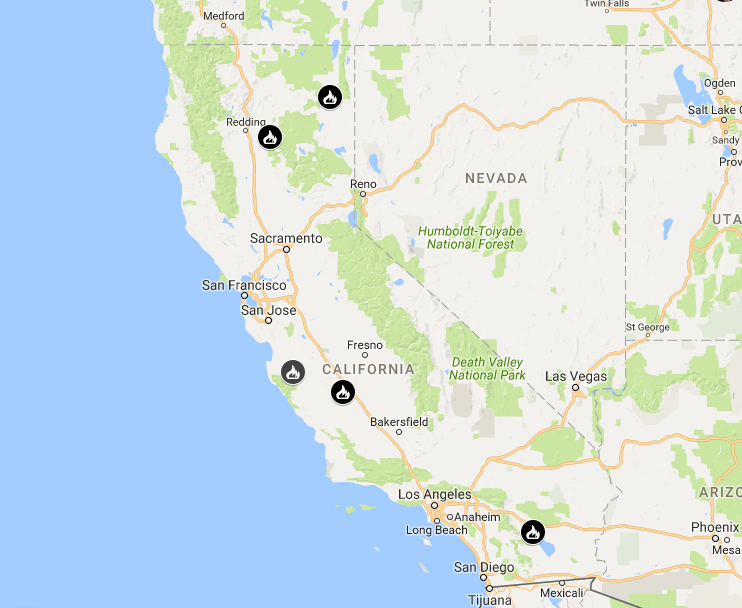
Since the beginning of 2016, a total of approximately 7,200 wildfires have burned almost 570,000 acres across the state (as of 12/12/16). There are now 5 active wildfires in California, according to InciWeb, a national all-risk incident information management system. All wildfires are fully contained.

Please note that wildfire data are preliminary and may change. They are updated daily by the National Interagency Coordination Center.

Hydropower

Statewide hydroelectric power generation in September 2016 was about 2,300,000 MWh, representing a 65% increase over last year’s September production of 1,400,000 MWh. Total generation is about 7% below the 2001-2011 average for the same month.

Groundwater Conditions

The most recent data on groundwater conditions are based on measurements taken in spring 2016. Maps of spring and fall groundwater level changes can be found here. Parts of the Tulare Lake, the South Coast, and the Colorado River hydrologic regions have experienced groundwater declines of more than 100 feet between fall 2011 and fall 2015.

Additional Resources


Newsletter